Marbella
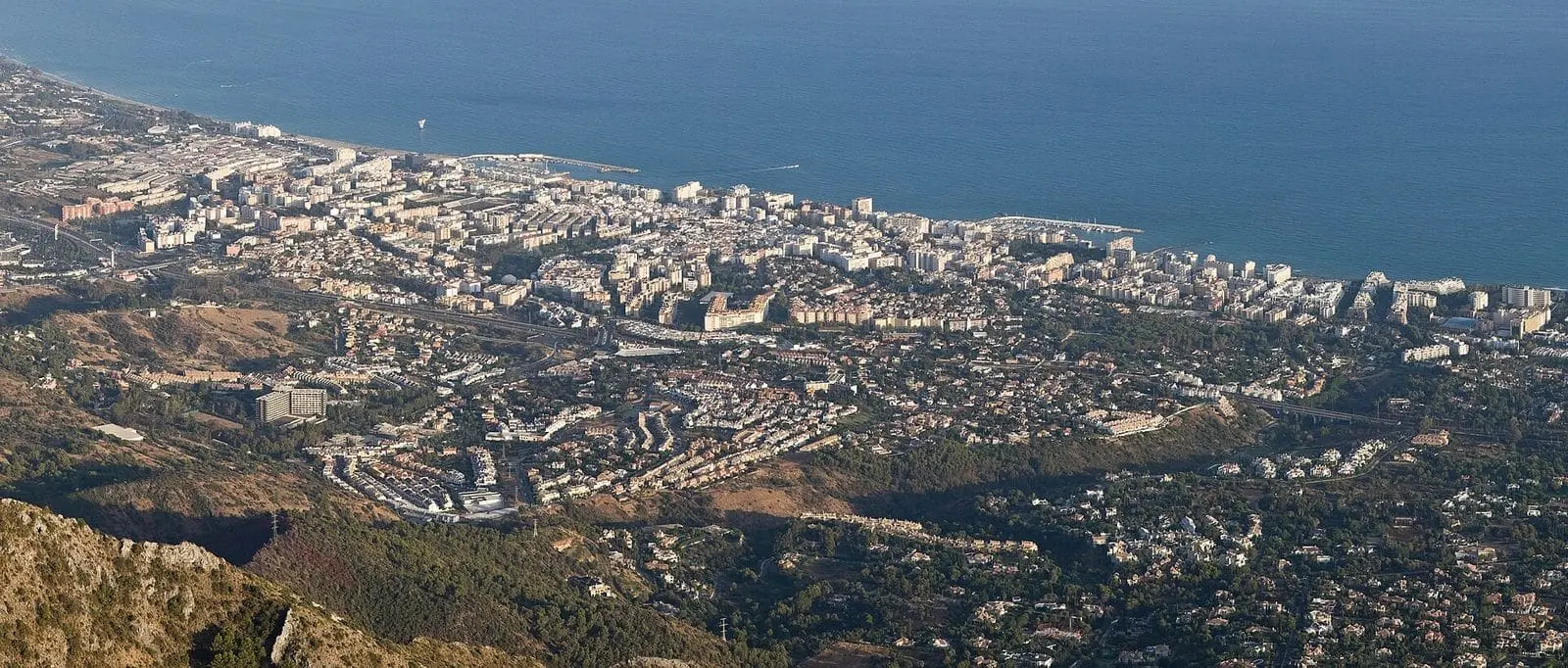
A smart resort with a compact old town on the Mediterranean.
3m 16s
of totality, starting at (UTC+2) on Monday 2 August 2027.
Where to look
39° up in the east.
Well up, but buildings can still hide it from narrow streets: pick a square, beach or rooftop with a view east (96° from true north).
- Eclipse begins
- 09:41 CEST. Glasses on from here.
- Clear sky
- 81% of days were clear at this hour.
- Temperature
- 24 °C average in the shade.

Some links below open hotel and tour searches on partner sites. If you book or buy through them, I may earn a commission, at no extra cost to you. It does not change what I recommend. Affiliate disclosure.
| A bed for the night of 1 August | Search rooms in Marbella or the nearest other base, Málaga (45 min drive, in the path with 1m 54s of totality). |
|---|---|
| On this page | All the places to stay, a plan B in nearby towns and eclipse-day mode. |
Weather at eclipse time
31 years of weather within 7 days of 2 August, at the hour of maximum eclipse. They give the odds from past years and are not a forecast.
Clear-sky odds
81%
Usually clear at this hour.
Share of days around 2 August with 20% cloud or less at 10:49 local time, the moment of maximum eclipse.
- Mean cloud
- 12% at eclipse time
- Cloudy days
- 5% 70% cloud or more, about 1 in 20
- Temperature
- 24 °C average at totality
- Hot days
- 26 °C or more, 1 day in 10
Mean cloud that year. 31-year mean, 12%. Clearest year 2006 (3%), cloudiest 2017 (28%).
Year by year
| Year | Mean cloud | Year | Mean cloud |
|---|---|---|---|
| 1995 | 13.4% | 2011 | 16.6% |
| 1996 | 4.9% | 2012 | 11.3% |
| 1997 | 13.4% | 2013 | 13.3% |
| 1998 | 8.8% | 2014 | 6.1% |
| 1999 | 27.7% | 2015 | 21.5% |
| 2000 | 3.7% | 2016 | 5.8% |
| 2001 | 17.3% | 2017 | 27.9% |
| 2002 | 18.8% | 2018 | 4.1% |
| 2003 | 8.5% | 2019 | 14.5% |
| 2004 | 14.4% | 2020 | 13.4% |
| 2005 | 18.5% | 2021 | 21.4% |
| 2006 | 2.6% | 2022 | 5.9% |
| 2007 | 9.4% | 2023 | 3.2% |
| 2008 | 6.4% | 2024 | 3.1% |
| 2009 | 8.5% | 2025 | 4.0% |
| 2010 | 17.1% |
ERA5 reanalysis (Copernicus Climate Change Service, CC BY 4.0), my calculation. Contains modified Copernicus Climate Change Service information 2026. 465 days (1995–2025, 2 August ± 7 days) at the model grid point nearest this place. ERA5 cells are about 25 km across and its cloud cover is a model estimate, so coastal fog and mountain cloud can be blurred. Thin high cloud counts as cloud here, though totality often shows through it, so the odds lean cautious. Temperatures are shade air temperatures on a normal day; the eclipse cools the air briefly. Methods.
Getting there
By air
- AGP
Málaga–Costa del Sol Airport
About 50 min by road to Marbella (free-flow)
- GIB
Gibraltar International Airport
About 1h 00m by road to Marbella (free-flow)
On eclipse morning a car lets you move if cloud rolls in. Prefer a free-cancellation rate.
Driving in to Marbella on eclipse morning
- Totality begins
- 10:46:50 CEST
- Partial phase from
- 09:41 CEST
| Base | Drive | Distance | Leave by† | Morning timeline |
|---|---|---|---|---|
| Stay in Marbella: | – | – | 09:15 CEST | |
| Málaga: | 45m 60 km | 60 km | 08:30 CEST | |
| Algeciras: | 1h 02m 82 km | 82 km | Stay put 4m 28s there, 1m 12s more than Marbella | Already in the path, so there is no need to drive. |
| Gibraltar: | 1h 04m 78 km | 78 km | Stay put 4m 27s there, 1m 11s more than Marbella | Already in the path, so there is no need to drive. |
| Jerez de la Frontera: | 2h 03m 171 km | 171 km | 06:35 CEST | |
| Granada | 2h 09m 179 km | 179 km | 06:30 CEST |
Getting around Spain
Fly. Málaga (AGP) is the big international gateway and lies just inside the path. Jerez (XRY) is inside it too. Seville (SVQ) and Granada (GRX) are outside but within roughly one to two and a half hours of good sites. Gibraltar (GIB) is a walk away from La Línea across a land border with no checks since July 2026. Melilla (MLN) has flights to the mainland.
Train. Renfe high-speed trains link Madrid with Málaga and, via Seville, with Cádiz; regional trains run Seville–Jerez–Cádiz. The branch to Algeciras via Ronda has been subject to long engineering closures with replacement buses, so check Renfe before relying on it in eclipse week.
Ferry. Fast ferries run from Tarifa to Tangier’s city port and from Algeciras to Tanger Med and to Ceuta, each crossing taking around an hour or a little more. Málaga and Almería have longer sailings to Melilla, and Almería to Nador in Morocco. Early August is the peak of Operación Paso del Estrecho, the summer crossing season: 646,000 passengers sailed in its first month in 2026, with Algeciras–Tanger Med the busiest line and Tarifa–Tangier second. Book car space early and expect queues; foot passengers have an easier time.
Car. A hire car is the most flexible way to chase clear sky between the Atlantic and Mediterranean coasts. The A-7/AP-7 motorways follow the Costa del Sol; the single N-340 is the main road through Tarifa and congests in summer.
Eclipse morning. Totality comes at about 10:45–10:50 CEST, and the partial phase starts roughly an hour earlier, so roads fill from dawn. Spain’s traffic authority (DGT) gave this guidance for the 2026 eclipse: never stop on the hard shoulder or carriageway to watch, park only where it is allowed, keep phones and cameras out of your hands while driving, and do not rush off afterwards; staying put for a while lets the exodus thin out. Check the DGT for any update for 2027.
Night of 1 August
Where to stay
Finding a room
Marbella is one of my bases: inside the path with over three minutes. The largest hotel stock between Málaga and Gibraltar; no rail, so plan around the coastal motorways, which will be busy.
If you stay in Gibraltar, you can watch from there without driving: it gets 4m 27s of totality.
As of 26 November 2026. Nobody has published occupancy figures for the night of 1–2 August 2027, but the asking prices listed so far are very high. In August 2026 Euronews searched Booking.com for two adults in Tarifa on 1–2 August 2027: the three results were listed at €11,090, €12,500 and €13,260 a night, and it reported, without naming them, that some Cádiz hotels had stopped taking bookings for August 2027 for a while. The Olive Press found an apartment in Estepona listed at €4,233 for the night and a double room in a central Málaga hotel at €7,592, and quoted the rental platform Holidu: demand in the zone of totality was six times that of an average day. These are listing prices seen a year ahead, not what anyone paid, and they move daily. Early August is peak season on the Costa del Sol and Costa de la Luz anyway, and CNN, citing The Independent, reported select Spanish hotel prices up 135% ahead of Spain’s 12 August 2026 eclipse. Expect the sharpest pressure where totality is longest: Tarifa, Algeciras, Barbate, Vejer, Conil and the western Costa del Sol around Estepona and Marbella.
More on finding a room in Spain
My suggestions
- Book something refundable now, even if it is not perfect, then keep watching: rooms other people cancel come back onto the market, so search again in July even if you are booked.
- Sleep outside the path, drive in. Seville, Córdoba, Granada and inland Andalusian towns have large hotel stocks. Cádiz and Jerez are inside the path near its northern edge. From Seville, the longer-totality coast is roughly 1½ to 2½ hours away in normal traffic; double that margin on eclipse morning.
- Ceuta offers the longest Spanish totality and Melilla a little less than Tarifa. Both have small hotel stocks; Ceuta is a ferry hop from Algeciras, and Melilla has flights as well as ferries. Book early or treat them as day trips, and note the US advisory for Ceuta.
- Camping: use licensed campsites. Free camping is restricted in Andalusia, and August fire rules are strict.
- Look across the Strait. Northern Morocco is close, often cheaper, and closer to the central line. Gibraltar (no land-border checks now) is a walk from La Línea, but its hotels are few.
Search rooms for 1 Aug to 3 Aug 2027
- Search rooms
Marbella
- Search rooms
Málaga
- Search rooms
Gibraltar
For other bases along the path, see Where to stay.
Hotels near Marbella on a map
The map loads Stay22, which may set cookies. Nothing loads until you ask for it.
Minute by minute
All times on Marbella’s clock for the total solar eclipse of Monday 2 August 2027, computed for 36.5167°, −4.8833° at 56 m.
-
First contact (C1) T−1h 05m
The Moon takes its first nick out of the Sun. Glasses on.
25° up E
-
Half the Sun covered T−28m 02s
Hardly darker yet: your eyes adapt as the light fades.
50% covered
-
90% covered T−6m 45s
The light thins and shadows sharpen. Keep the glasses on.
90% covered
-
Totality begins (C2) T 0
The last bead of sunlight vanishes. Glasses off: the corona is safe to look at now.
39° up E
-
Maximum eclipse T+1m 38s
The middle of totality. Look around the horizon, which glows like a sunset all the way round.
39° up E
-
Totality ends (C3) T+3m 16s
The first flash of sunlight returns. Glasses back on at once.
39° up E
-
Last contact (C4) T+1h 15m
The Moon slides off the Sun. The eclipse is over.
53° up ESE
Look at the partly eclipsed Sun only through ISO 12312-2 eclipse glasses or a solar viewer; take them off only once totality has begun, and put them back on as soon as the Sun reappears. Eye safety guide.
Closer to the central line
Totality is longest on the central line and drops off fast near the edges. The chart shows the whole width of the path through Marbella.
Totality across the path through Marbella. Seconds of totality against distance from the central line.
Move towards the central line
The central line, 88 km to the south, gets 4m 54s: 1m 38s more than Marbella.
- 5 km south: 3m 29s, +13 s Map →
- 30 km south: 4m 16s, +1m 00s Map →
- 75 km south: 4m 52s, +1m 36s Map →
- 88 km south, on the line: 4m 54s, +1m 38s Map →
Straight-line distances from the town centre, heading south, at Marbella’s elevation. The line may cross sea, private land or roadless country: check each point on the map.
Show the cross-section as a table
| Distance from central line | Totality | Against Marbella |
|---|---|---|
| 120 km S | partial only | – |
| 110 km S | 1m 52s | −1m 25s |
| 100 km S | 2m 40s | −37 s |
| 90 km S | 3m 13s | −3 s |
| 80 km S | 3m 38s | +22 s |
| 70 km S | 3m 59s | +42 s |
| 60 km S | 4m 15s | +59 s |
| 50 km S | 4m 28s | +1m 11s |
| 40 km S | 4m 38s | +1m 22s |
| 30 km S | 4m 45s | +1m 29s |
| 20 km S | 4m 50s | +1m 34s |
| 10 km S | 4m 53s | +1m 37s |
| Central line | 4m 54s | +1m 38s |
| 10 km N | 4m 53s | +1m 37s |
| 20 km N | 4m 50s | +1m 34s |
| 30 km N | 4m 44s | +1m 28s |
| 40 km N | 4m 37s | +1m 21s |
| 50 km N | 4m 26s | +1m 10s |
| 60 km N | 4m 13s | +57 s |
| 70 km N | 3m 57s | +41 s |
| 80 km N | 3m 37s | +21 s |
| 90 km N | 3m 12s | −4 s |
| 100 km N | 2m 39s | −37 s |
| 110 km N | 1m 52s | −1m 24s |
| 120 km N | partial only | – |
About Marbella
Marbella mixes a compact Moorish-era old town with the marina scene of Puerto Banús and miles of beaches, under the grey limestone of La Concha mountain.
Totality varies little along this stretch of coast. From the beaches the Sun is over the sea.
It has one of the biggest hotel stocks on the Costa del Sol but August prices are high. The Artola dunes at Cabopino, east of town, are a protected stretch of natural coast with more room than the city beaches.
| Region | Málaga, Andalusia |
|---|---|
| Population | 159,786 |
| Good for | Beach, city and family |
Viewpoints
Each spot’s totality is computed for its own coordinates. Any spot with an open view to the east will do.
Plaza de los Naranjos
Old-town square; buildings limit the view, so step out to the seafront for totality.
- Totality
- 3m 18s +2 s against the town centre
- From the centre
- 0.7 km SSW 36.5102°, −4.8850°
Dunas de Artola
Protected dunes and boardwalk at Cabopino with a natural beach.
- Totality
- 3m 26s +10 s against the town centre
- From the centre
- 13 km ESE 36.4866°, −4.7427°
Puerto Banús
Marina and beaches west of town; lively, crowded.
- Totality
- 3m 24s +8 s against the town centre
- From the centre
- 7.0 km WSW 36.4875°, −4.9525°
Things to do
Things to do in and around Marbella in the days either side of 2 August.
Culture
The old town
Whitewashed lanes fanning out from the Plaza de los Naranjos, a square of orange trees with the old town hall and the Church of the Incarnation close by.
Source: for The old town, andaluciamia.com (opens in a new tab)
Culture
Museo del Grabado Español
A small museum of Spanish printmaking in the old town: a cool hour out of the August sun.
Source: for Museo del Grabado Español, andaluciamia.com (opens in a new tab)
Day trip
Ronda and its gorge
The town split by the El Tajo gorge, up in the mountains behind the coast. The Ronda page has its eclipse times.
Source: for Ronda and its gorge, multimedia.andalucia.org (opens in a new tab)
Day trips and tours from Marbella:
Picks checked 17 Nov 2026. Hours, prices and access change, so confirm before you go. No pick is paid for.
- Eye safety guide Which glasses to trust, and the only moment you can take them off.
- Experiments Things to try on the day, from pinhole crescents to shadow bands.
- The sky at totality Which planets and stars you can see during totality.
Nearby towns
The closest towns on my list, in case the forecast for Marbella is poor. Differences are against Marbella.
| Town | Distance | Totality | Clear sky |
|---|---|---|---|
| Fuengirola, Spain, 23 km E | 23 km E | 3m 11s −5 s | 79% |
| Estepona, Spain, 26 km WSW | 26 km WSW | 3m 38s +22 s | 82% |
| Ronda, Spain, 35 km NW | 35 km NW | 1m 25s −1m 52s | 81% |
| Casares, Spain, 36 km WSW | 36 km WSW | 3m 32s +16 s | 82% |
| Sotogrande, Spain, 45 km SW | 45 km SW | 4m 07s +51 s | 73% |
| Málaga, Spain, 47 km ENE | 47 km ENE | 1m 54s −1m 23s | 76% |
If this page helped you plan, you can buy me a coffee.
Buy me a coffee (opens in a new tab)