Jeddah, جدة
A Red Sea port with a coral-stone old town and a long corniche.
5m 55s
of totality, starting at (UTC+3) on Monday 2 August 2027.
Travel advisory. Read the official advice before you go
Where to look
76° up in the west.
Tilt your head right back, facing west, or lie on a mat or a reclining chair.
- Eclipse begins
- 12:00 AST. Glasses on from here.
- Clear sky
- 61% of days were clear at this hour.
- Temperature
- 36 °C average in the shade, hot.

Some links below open hotel and tour searches on partner sites. If you book or buy through them, I may earn a commission, at no extra cost to you. It does not change what I recommend. Affiliate disclosure.
| A bed for the night of 1 August | Search rooms in Jeddah or the nearest other base, Taif (2h 43m drive, in the path with 3m 51s of totality). |
|---|---|
| On this page | All the places to stay, a plan B in nearby towns and eclipse-day mode. |
Weather at eclipse time
31 years of weather within 7 days of 2 August, at the hour of maximum eclipse. They give the odds from past years and are not a forecast.
Clear-sky odds
61%
Often clear. Have a backup site.
Share of days around 2 August with 20% cloud or less at 13:25 local time, the moment of maximum eclipse.
- Mean cloud
- 24% at eclipse time
- Cloudy days
- 13% 70% cloud or more, about 1 in 8
- Temperature
- 36 °C average at totality
- Hot days
- 37 °C or more, 1 day in 10
Heat warning. It averages 36 °C in the shade at eclipse time here, and 1 day in 10 reaches 37 °C. Plan for shade and plenty of water, and keep phones and cameras out of direct sun: they overheat.
Mean cloud that year. 31-year mean, 24%. Clearest year 2010 (7%), cloudiest 2024 (55%).
Year by year
| Year | Mean cloud | Year | Mean cloud |
|---|---|---|---|
| 1995 | 28.1% | 2011 | 11.7% |
| 1996 | 24.2% | 2012 | 20.2% |
| 1997 | 27.9% | 2013 | 37.8% |
| 1998 | 17.8% | 2014 | 22.1% |
| 1999 | 9.3% | 2015 | 14.3% |
| 2000 | 12.3% | 2016 | 33.3% |
| 2001 | 26.0% | 2017 | 19.9% |
| 2002 | 17.2% | 2018 | 24.7% |
| 2003 | 23.5% | 2019 | 27.2% |
| 2004 | 32.2% | 2020 | 46.1% |
| 2005 | 24.9% | 2021 | 22.7% |
| 2006 | 26.7% | 2022 | 32.1% |
| 2007 | 17.3% | 2023 | 13.2% |
| 2008 | 26.9% | 2024 | 55.4% |
| 2009 | 14.9% | 2025 | 36.1% |
| 2010 | 6.7% |
ERA5 reanalysis (Copernicus Climate Change Service, CC BY 4.0), my calculation. Contains modified Copernicus Climate Change Service information 2026. 465 days (1995–2025, 2 August ± 7 days) at the model grid point nearest this place. ERA5 cells are about 25 km across and its cloud cover is a model estimate, so coastal fog and mountain cloud can be blurred. Thin high cloud counts as cloud here, though totality often shows through it, so the odds lean cautious. Temperatures are shade air temperatures on a normal day; the eclipse cools the air briefly. Methods.
Getting there
By air
- JED
King Abdulaziz International Airport (Jeddah)
About 20 min by road to Jeddah (free-flow)
On eclipse morning a car lets you move if cloud rolls in. Prefer a free-cancellation rate.
Driving in to Jeddah on eclipse morning
- Totality begins
- 13:22:16 AST
- Partial phase from
- 12:00 AST
| Base | Drive | Distance | Leave by† | Morning timeline |
|---|---|---|---|---|
| Stay in Jeddah: | – | – | 11:50 AST | |
| Taif: | 2h 43m 205 km | 205 km | 08:10 AST |
Getting around Saudi Arabia
Check the advisories first. Flights and roads can be disrupted at short notice; the FCDO says further attacks on airports are very likely.
Fly. Jeddah (JED) is the main gateway inside the path. Taif (TIF), Al Baha (ABT), Abha (AHB), Jizan (GIZ) and Najran (EAM) are regional airports in or near it.
Train. The Haramain high-speed railway links Mecca, Jeddah (including the airport) and Medina. Non-Muslims may not travel to Mecca.
Road. The coast road south of Jeddah through Al Lith follows the Tihamah plain, where totality is longest and skies are sunniest. Roads into Mecca are closed to non-Muslims, so follow the signed routes around the city. The FCDO describes driving standards as poor; UK photocard licences are valid for three months, and hire firms may ask for an International Driving Permit.
Eclipse afternoon. Totality is at about 13:22 AST in Jeddah and 13:34 in Abha, with the partial phase starting some 80 minutes earlier in the midday heat. Do not photograph military or security sites.
Night of 1 August
Where to stay
Finding a room
Jeddah is one of my bases: inside the path with about six minutes. Main international airport and large hotel supply; check official advisories first.
As of 16 November 2026. I have found no eclipse-specific availability data for Saudi Arabia. Jeddah has a large hotel stock, and the eclipse falls well away from the Hajj season.
More on finding a room in Saudi Arabia
If the advice eases
- Book only refundable rooms and check that your travel insurance covers a destination under FCDO or State Department warnings; travelling against FCDO advice can invalidate UK policies.
- Base in Jeddah and drive south along the coast early on the day: sunnier than the mountains, with slightly longer totality.
- Taif and Al Baha are cooler mountain alternatives, but cloudier, and US government staff need special permission to visit Taif.
- Asir (including Abha and Khamis Mushait), Jizan and Najran: Canada advises against all travel to these provinces. Check your own government’s advice and your insurance before booking there.
Search rooms for 1 Aug to 3 Aug 2027
- Search rooms
Jeddah
- Search rooms
Taif
For other bases along the path, see Where to stay.
Hotels near Jeddah on a map
The map loads Stay22, which may set cookies. Nothing loads until you ask for it.
Minute by minute
All times on Jeddah’s clock for the total solar eclipse of Monday 2 August 2027, computed for 21.5433°, 39.1728° at 13 m.
-
First contact (C1) T−1h 21m
The Moon takes its first nick out of the Sun. Glasses on.
82° up ESE
-
Half the Sun covered T−33m 24s
Hardly darker yet: your eyes adapt as the light fades.
50% covered
-
90% covered T−7m 28s
The light thins and shadows sharpen. Keep the glasses on.
90% covered
-
Totality begins (C2) T 0
The last bead of sunlight vanishes. Glasses off: the corona is safe to look at now.
77° up WSW
-
Maximum eclipse T+2m 58s
The middle of totality. Look around the horizon, which glows like a sunset all the way round.
76° up WSW
-
Totality ends (C3) T+5m 55s
The first flash of sunlight returns. Glasses back on at once.
76° up WSW
-
Last contact (C4) T+1h 21m
The Moon slides off the Sun. The eclipse is over.
58° up W
Look at the partly eclipsed Sun only through ISO 12312-2 eclipse glasses or a solar viewer; take them off only once totality has begun, and put them back on as soon as the Sun reappears. Eye safety guide.
Closer to the central line
Totality is longest on the central line and drops off fast near the edges. The chart shows the whole width of the path through Jeddah.
Totality across the path through Jeddah. Seconds of totality against distance from the central line.
Move towards the central line
The central line, 40 km to the south-west, gets only 19 s more.
- 5 km south-west: 6m 00s, +4 s Map →
- 20 km south-west: 6m 09s, +14 s Map →
- 30 km south-west: 6m 13s, +18 s Map →
- 40 km south-west, on the line: 6m 14s, +19 s Map →
Straight-line distances from the town centre, heading south-west, at Jeddah’s elevation. The line may cross sea, private land or roadless country: check each point on the map.
Show the cross-section as a table
| Distance from central line | Totality | Against Jeddah |
|---|---|---|
| 130 km S | partial only | – |
| 120 km S | 2m 21s | −3m 34s |
| 110 km S | 3m 18s | −2m 37s |
| 100 km S | 3m 59s | −1m 56s |
| 90 km S | 4m 30s | −1m 25s |
| 80 km S | 4m 55s | −1m 00s |
| 70 km S | 5m 16s | −39 s |
| 60 km S | 5m 33s | −23 s |
| 50 km S | 5m 46s | −9 s |
| 40 km S | 5m 57s | +1 s |
| 30 km S | 6m 05s | +9 s |
| 20 km S | 6m 10s | +15 s |
| 10 km S | 6m 13s | +18 s |
| Central line | 6m 14s | +19 s |
| 10 km N | 6m 13s | +17 s |
| 20 km N | 6m 09s | +14 s |
| 30 km N | 6m 03s | +8 s |
| 40 km N | 5m 55s | ±0 s |
| 50 km N | 5m 44s | −11 s |
| 60 km N | 5m 30s | −25 s |
| 70 km N | 5m 14s | −42 s |
| 80 km N | 4m 53s | −1m 02s |
| 90 km N | 4m 28s | −1m 27s |
| 100 km N | 3m 57s | −1m 59s |
| 110 km N | 3m 17s | −2m 38s |
| 120 km N | 2m 21s | −3m 34s |
| 130 km N | partial only | – |
About Jeddah
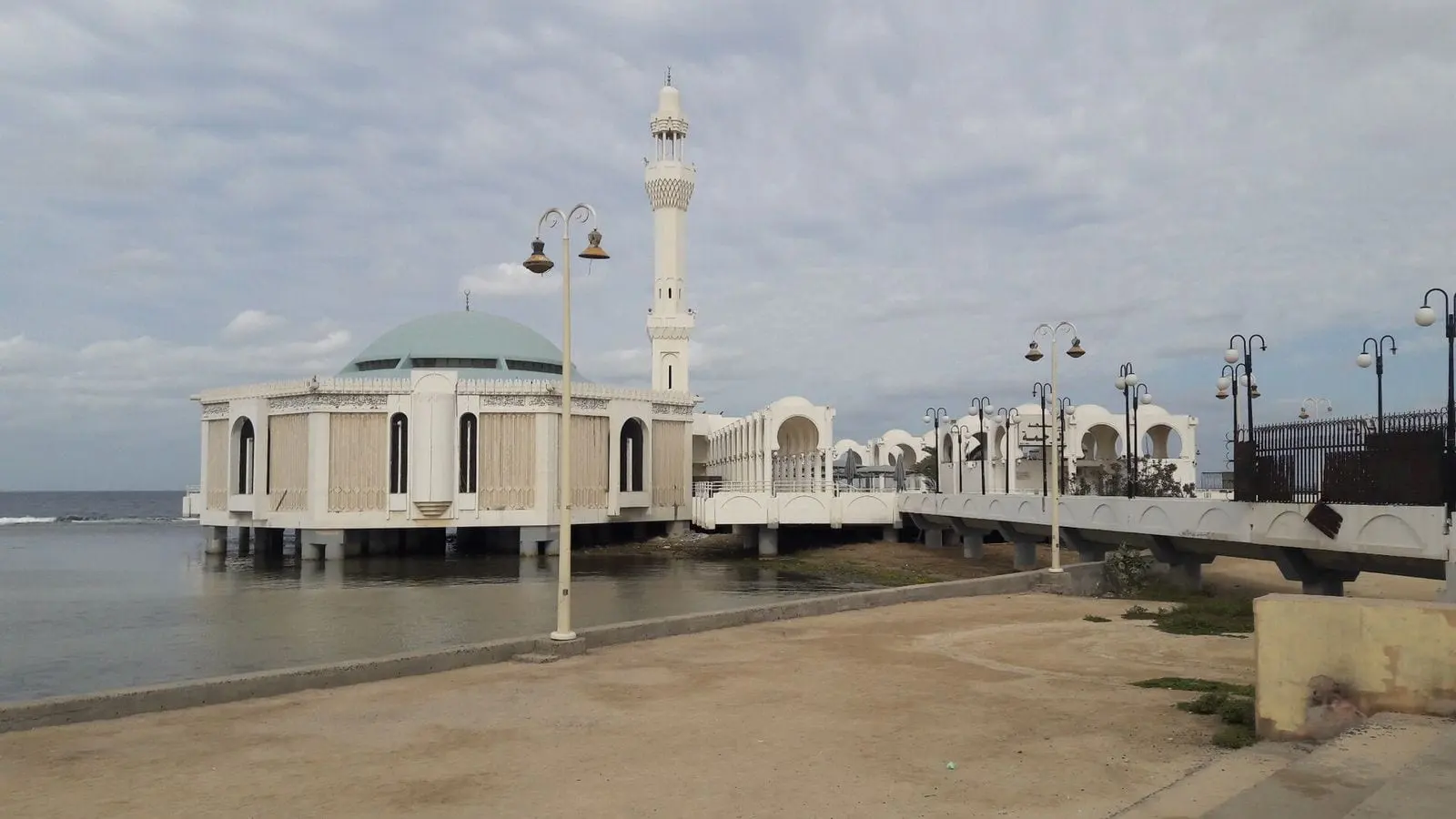
Jeddah is Saudi Arabia’s Red Sea gateway: a huge modern city around the UNESCO-listed historic district of Al-Balad, with its coral-stone houses and wooden balconies, and a long seafront corniche.
The eclipse comes in the early afternoon, with the Sun in the west-south-west, so the corniche looks out over the sea towards it.
Expect intense, humid heat. Jeddah has the main international airport for the region. Jeddah is open to non-Muslim visitors, but Mecca, about 70 km inland, is not. Read the advisory before planning a trip.
| Region | Makkah Province |
|---|---|
| Population | 4,697,000 |
| Good for | City, beach and historic |
Viewpoints
Each spot’s totality is computed for its own coordinates. Any spot with an open view to the west will do.
Al-Balad
Historic district of coral-stone houses; lanes are narrow, squares give open sky.
Before or after. The UNESCO-listed old town of coral-stone tower houses with carved wooden roshan screens, built by merchants of the pilgrim port.
Source: for Al-Balad, historic Jeddah, whc.unesco.org (opens in a new tab)
- Totality
- 5m 59s +4 s against the town centre
- From the centre
- 6.8 km S 21.4833°, 39.1833°
North Corniche
Seafront promenade in the north of the city.
- Totality
- 5m 53s −3 s against the town centre
- From the centre
- 12 km NW 21.6335°, 39.1042°
King Fahd’s Fountain area
Waterfront by the giant fountain in the central corniche.
Before or after. A jet that reaches about 312 m off the Corniche, listed as the world’s tallest fountain. It is usually switched on in the evening.
Source: for King Fahd’s Fountain, arabnews.com (opens in a new tab)
- Totality
- 5m 59s +4 s against the town centre
- From the centre
- 4.2 km SW 21.5156°, 39.1450°
Visiting notes checked 17 Nov 2026. Confirm hours and access before you go.
Things to do
Things to do in and around Jeddah in the days either side of 2 August.
Read the travel advisory above before you book anything here.
Food & markets
The Corniche at sunset
The seafront promenade on the Red Sea, with restaurants, kiosks and beaches along it and King Fahd’s Fountain offshore. Come as the light goes and the heat eases.
Source: for The Corniche at sunset, en.wikipedia.org (opens in a new tab)
Day trips and tours from Jeddah:
Picks checked 22 Nov 2026. Hours, prices and access change, so confirm before you go. No pick is paid for.
- Eye safety guide Which glasses to trust, and the only moment you can take them off.
- Experiments Things to try on the day, from pinhole crescents to shadow bands.
- The sky at totality Which planets and stars you can see during totality.
Nearby towns
The closest towns on my list, in case the forecast for Jeddah is poor. Differences are against Jeddah.
| Town | Distance | Totality | Clear sky |
|---|---|---|---|
| Mecca, Saudi Arabia, 69 km E. Travel advisory | 69 km E | 5m 06s −50 s | 56% |
| Taif, Saudi Arabia, 131 km ESE. Travel advisory | 131 km ESE | 3m 51s −2m 05s | 30% |
| Al Baha, Saudi Arabia, 293 km SE. Travel advisory | 293 km SE | 5m 09s −46 s | 7% |
| Berenice, Egypt, 462 km NW | 462 km NW | 6m 20s +25 s | 84% |
If this page helped you plan, you can buy me a coffee.
Buy me a coffee (opens in a new tab)